Single Tooth Implants in Roselle, IL
A missing tooth left alone leads to bone loss, shifting teeth, and difficulty chewing. Of all tooth replacements, only dental implants preserve the jawbone and protect the health of neighboring teeth, so the gap deserves attention before those problems start. Each implant Dr. Llanes places at Modern Essence Dentistry matches a natural tooth in appearance, feel, and function, giving you a lasting, confident smile.
What it is
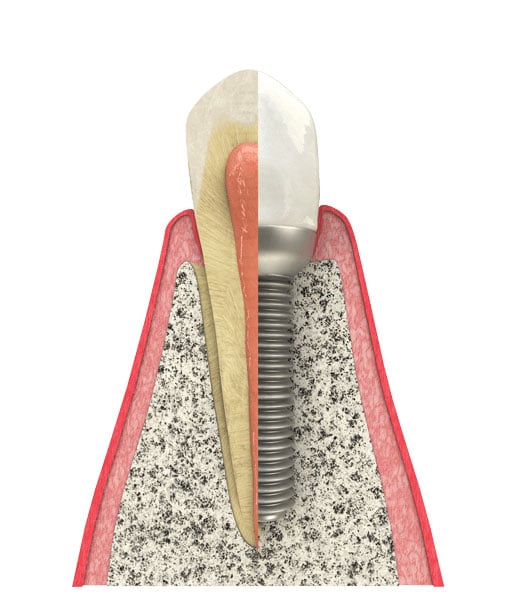
A missing tooth replaced from root to crown with a fixed, long-term restoration: a titanium post is surgically placed into the jawbone, fuses with the bone, and supports a custom porcelain crown.
Who it's for
Bone preserved and neighboring teeth untouched, for anyone who has lost a single tooth and wants a fixed, natural-looking replacement.
How we help
Custom treatment planning backed by digital imaging and an in-office CBCT 3D scan for precise placement, finished with a restoration that looks and functions exactly like your natural tooth.
Nothing comes closer to having your own natural tooth back than a dental implant. Request your implant evaluation today.

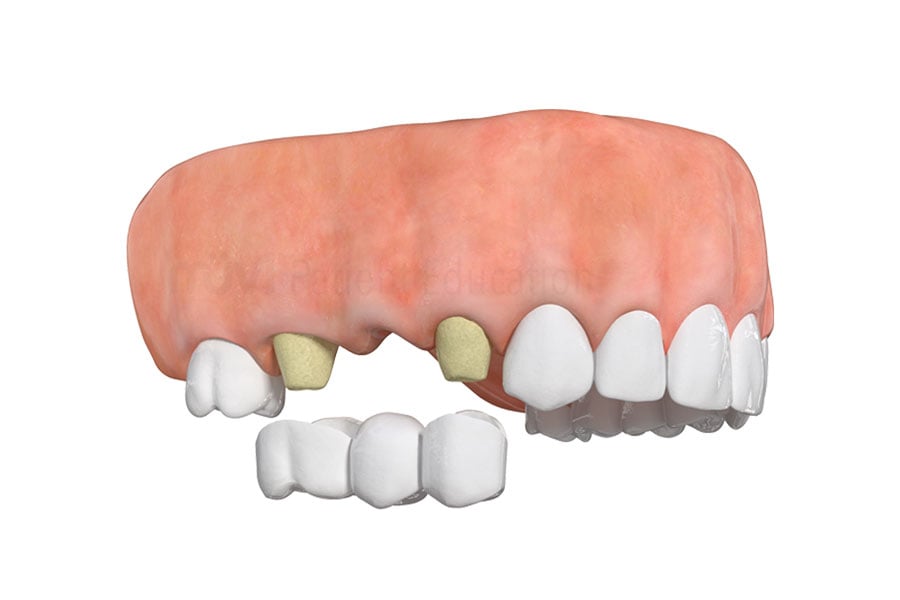
Dental Implant vs. Traditional Bridge
- Preserves neighbors: Standing on its own, an implant needs no filing down or crowning of the healthy adjacent teeth
- Prevents bone loss: Just like a natural root, the titanium post stimulates the jawbone and keeps it strong and healthy
- Built to last: Cared for well, a dental implant can last for many years, though how long varies from person to person, whereas bridges typically need replacement every 10–15 years
- Easier to maintain: Brush and floss it like any other tooth, without special tools or threading
- Natural feel: In look, feel, and function, an implant matches your real tooth exactly
- A bridge, by contrast, needs both teeth beside the gap crowned, and over time those teeth can be damaged
Why Choose an Implant?
- Looks natural: Your new tooth is virtually impossible to tell apart from your real teeth
- Eat anything: With no dietary restrictions, you can bite and chew with full confidence
- Stays in place: Permanently anchored in your jawbone, it never slips, shifts, or needs adhesives
- Protects your jaw: It prevents the bone deterioration that sets in when a tooth root is missing
- One-time investment: Unlike bridges and dentures, implants don't need refitting or replacing
- To make implants affordable, learn about our flexible financing options
The Implant Process
- Consultation: With digital X-rays and an in-office CBCT 3D scan, Dr. Llanes examines your teeth to create a precise treatment plan
- Implant placement: Under local anesthesia, a small titanium post is placed into the jawbone
- Healing period: The implant fuses with the bone over 3–6 months, a process called osseointegration
- Abutment: A connector piece is fitted onto the implant to support the crown
- Crown placement: A custom porcelain crown is attached to complete your new tooth
- In some cases, bone grafting is needed before the implant can be placed
Find out if you're a candidate. Dental implants are the gold standard for tooth replacement.
What to Expect at Your Visit
Visit Steps
- Evaluation: Using advanced diagnostic imaging, Dr. Llanes thoroughly examines your teeth and jawbone
- Treatment plan: You receive a personalized plan covering timeline, cost, and what to expect at each stage
- Implant surgery: Performed under local anesthesia, the procedure leaves most patients reporting minimal discomfort
- Healing: Over several months, the implant integrates with your jawbone
- Final restoration: Your custom crown is placed to complete your new smile
Helpful Tips
- The day after implant surgery, most patients are back to normal activities
- For successful healing, follow your post-operative care instructions carefully
- During the initial healing period, avoid hard or crunchy foods near the implant site
- Brush twice daily and floss around the implant to maintain excellent oral hygiene
- Keep all follow-up appointments so Dr. Llanes can monitor your healing progress
- Given proper care, your dental implant can last for many years, though how long varies from person to person
Frequently Asked Questions
Most single dental implant treatments take between 3 and 6 months from the day the implant is placed to the day your final crown is attached. The majority of that time is not spent in the dental chair. It is healing time, during which the titanium post fuses with your jawbone in a natural process called osseointegration. This biological bond is what gives a dental implant the strength and stability to function like a real tooth root, so it cannot be rushed.
Your individual timeline depends on your starting point. If the tooth was removed recently and the surrounding bone is healthy, treatment tends to move on the shorter end. If bone volume has been lost, a preliminary bone grafting procedure may be needed first, and the graft needs its own healing window before the implant goes in. Once the implant has integrated, placing the abutment and custom crown usually takes just a couple of short visits.
Dr. Llanes will map out a realistic, stage-by-stage timeline during your consultation, using digital X-rays and our in-office CBCT 3D scan to see exactly what your case involves. You will know up front how many visits to expect and roughly how long each healing phase will last, so there are no surprises along the way.
Placing a dental implant is far more comfortable than most people expect. The procedure is performed under local anesthesia that fully numbs the area, so you will not feel pain while the implant is placed. Many patients are surprised that surgery on the jawbone can feel so uneventful. If you feel nervous, Dr. Llanes can prescribe a mild oral relaxation medication to take before the appointment.
Afterward, any soreness is usually mild and short-lived. Most patients describe the recovery as similar to having a tooth extracted, and over-the-counter pain medication is typically all that is needed to stay comfortable. Applying ice for the first day, eating soft foods, and following your post-operative instructions helps healing go smoothly so you can get back to normal quickly.
A dental implant is built to be a long-term tooth replacement. The titanium post that anchors into your jawbone is biocompatible and does not decay, and once it has fused with the bone it can support your new tooth for many years, though how long varies from person to person. This longevity is one of the biggest reasons a dental implant is considered the gold standard for replacing a missing tooth.
The porcelain crown attached on top is the only part that experiences normal wear from daily biting and chewing. Over many years it may eventually need to be replaced. The single most important factor in how long your implant lasts is everyday care. Brushing twice a day, flossing around the implant, and keeping your routine checkups all protect the gum and bone that hold it secure.
Most healthy adults who are missing a single tooth make excellent candidates for a dental implant. The main requirement is enough healthy jawbone to anchor the titanium post, along with healthy gums and a commitment to good oral hygiene. Age is rarely a barrier on its own, and even patients who have worn a bridge or gone without a tooth for years are often surprised to learn they can still qualify.
If some bone has already been lost, that does not rule you out. A bone grafting procedure can rebuild the area first and create a strong foundation for the implant. Certain health conditions, uncontrolled diabetes, or heavy smoking can affect healing, so those factors are reviewed as part of planning your treatment.
Dr. Llanes will evaluate your specific situation using digital imaging and an in-office CBCT 3D scan to measure your bone and map the nerves and sinuses. This lets us tell you honestly whether a dental implant is the right choice for you and, if any groundwork is needed, exactly what that involves.
The cost of a dental implant depends on the details of your case, including whether you need a preliminary procedure such as bone grafting and the type of crown used to complete your tooth. Because every mouth is different, the most accurate way to know your investment is a consultation where we examine the site and build a treatment plan tailored to you.
While a dental implant often carries a higher upfront cost than a bridge, it is frequently the more economical choice over time. A bridge typically needs to be redone every 10 to 15 years and involves altering the healthy teeth beside the gap, whereas a well-cared-for implant stands on its own and can last for many years, though longevity varies from person to person. When you factor in long-term use, the value of an implant becomes clear.
At our Roselle, IL office we believe cost should never stand between you and a healthy smile. We offer flexible financing options and will review your dental insurance benefits with you, so you have a clear picture of your out-of-pocket investment before treatment begins.
A missing tooth is not just a cosmetic concern. The moment a tooth is gone, the surrounding structures begin to change, and those changes tend to build on each other over time. Replacing the tooth with a dental implant stops this chain reaction because the implant restores both the root and the crown, keeping everything around it stable.
Leaving the gap open can lead to a series of problems:
- Shifting teeth: Neighboring teeth drift into the empty space, throwing off your alignment
- Jawbone loss: Without a root to stimulate it, the bone in the area begins to shrink away
- Bite changes: Your upper and lower teeth no longer meet correctly, adding stress to your jaw
- Chewing difficulty: Missing a tooth makes it harder to eat comfortably and evenly
- Higher decay and gum disease risk: Tilted, crowded teeth are harder to clean around the gap
The longer a missing tooth goes unaddressed, the more the bone recedes and the more the bite drifts, which can make later treatment more involved and more costly. Acting sooner keeps your options simpler and your dental implant results more predictable.
Yes. Being without a tooth for months or even many years rarely means you have missed your chance at a dental implant. What often changes with time is the amount of jawbone in the area, because bone that no longer supports a tooth root gradually resorbs. The good news is that this bone can usually be rebuilt.
When the ridge has thinned, a bone grafting procedure restores volume and creates a solid foundation for the implant. In some cases the graft can be done at the same appointment as implant placement, and in others it heals first as a separate step. Either way, the goal is a stable base that lets your implant integrate securely and function like a natural tooth.
Dr. Llanes will assess your bone density with digital imaging and an in-office CBCT 3D scan, then recommend the approach that best restores both the bone and the tooth. Even long-standing gaps can usually be treated successfully, giving you back a complete, confident smile.
Request your dental implant evaluation today and get your smile back with a tooth that stays put.
Dental implant care at Modern Essence Dentistry is provided by general dentists. Our dentists do not hold a license in the dental specialties of oral and maxillofacial surgery, periodontics or prosthodontics.