Implant Bridge in Roselle, IL
Because an implant-supported bridge is anchored directly to your jawbone rather than relying on adjacent teeth the way traditional bridges do, it preserves bone, protects surrounding teeth, and provides a fixed, natural-looking result. When several neighboring teeth are missing, that makes it the most effective way to restore your smile, your bite, and your confidence. At Modern Essence Dentistry, Dr. Llanes will create a custom treatment plan to replace your missing teeth and restore full function.
What it is
When three or more teeth in a row are missing, one permanent, non-removable restoration fills the gap: a fixed bridge anchored to two or more dental implants instead of natural teeth.
Who it's for
Anyone missing several neighboring teeth who wants a stable, long-term solution: one that preserves bone and leaves the healthy adjacent teeth free from any altering.
How we help
A treatment plan tailored to your specific situation, guided by precise digital imaging for optimal implant placement and completed with custom-designed bridges that match your natural teeth.
An implant bridge restores your smile with teeth that stay put. Don't let missing teeth hold you back.
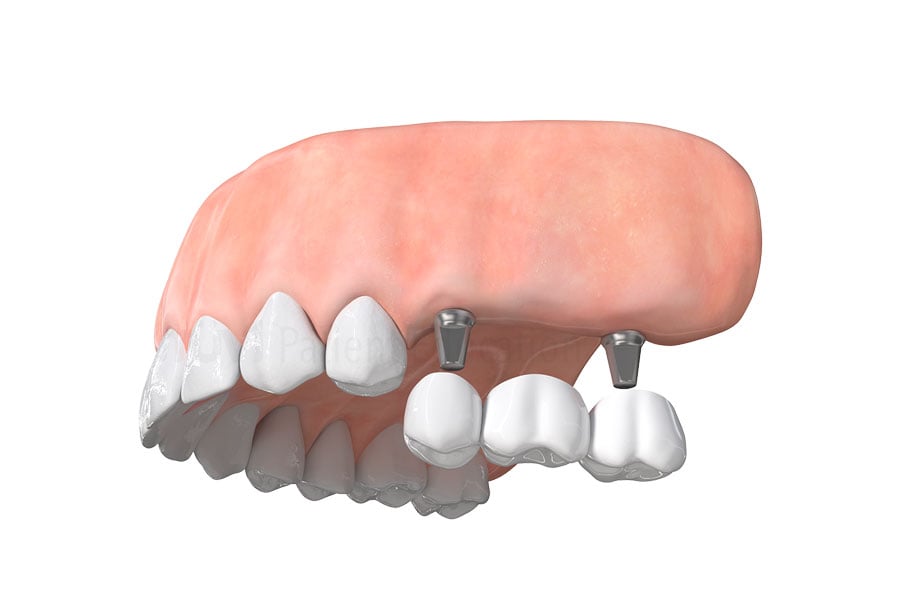
How an Implant Bridge Works
- The jawbone receives two or more titanium implants that serve as anchors
- Connected porcelain crowns form a custom bridge that attaches to those implants
- In a single, fixed restoration, the bridge replaces three or more missing teeth
- Your healthy teeth skip the filing and crowning that traditional bridges would require
- By stimulating the jawbone, the implants prevent the bone loss that comes with missing teeth
- The finished result looks, feels, and functions like your natural teeth

Why Replace Missing Teeth Now?
- Bone loss accelerates: With no tooth roots to stimulate it, the jawbone quickly begins to resorb and shrink
- Teeth shift: Surrounding teeth drift into the open spaces, creating misalignment and bite problems
- Remaining teeth are at risk: The teeth left to compensate for the missing ones take on extra stress and may be lost too
- Chewing becomes difficult: With teeth missing, your ability to eat a full range of foods drops
- Facial changes: As bone is lost, a sunken, aged appearance can develop around the jaw
- Acting sooner keeps treatment simpler and more affordable
Advantages of an Implant Bridge
- Beautiful, natural appearance: Porcelain crowns are custom-crafted to match your existing teeth perfectly
- Eat any food: Because an implant bridge is permanently fixed, you can bite, chew, and eat with full confidence
- No shifting or moving: Direct anchoring into the jawbone gives rock-solid stability
- Preserves bone: By stimulating the jawbone, the implants prevent the deterioration that comes with tooth loss
- Protects adjacent teeth: Traditional bridges mean grinding down healthy neighboring teeth, and this approach avoids that
- Long-lasting: Cared for properly, an implant bridge can last decades
The Treatment Process
- Consultation: Using digital X-rays and an in-office CBCT 3D scan, Dr. Llanes evaluates your teeth and jawbone
- Treatment plan: Based on the number of missing teeth and the bone available, a personalized plan is created
- Implant placement: Under local anesthesia, titanium posts are surgically placed into the jawbone
- Healing period: Over 3–6 months, the implants fuse with the bone in a process called osseointegration
- Bridge fabrication: Custom porcelain crowns are designed and joined together to form your bridge
- Final placement: With the bridge permanently fixed to your implants, your new teeth are complete
Replace missing teeth without compromising your healthy ones. Request your evaluation today.
What to Expect at Your Visit
Visit Steps
- Evaluation: Dr. Llanes reviews your imaging, examines your mouth, and talks through your goals and options
- Custom plan: You receive a detailed treatment plan covering timeline, cost, and what to expect at each stage
- Surgery: Your implants are placed under local anesthesia in our office, and a mild oral relaxation medication is available if you feel nervous
- Progress checks: Regular follow-up visits monitor your healing and keep everything on track
- Final restoration: After healing is complete, your custom bridge is permanently attached
Helpful Tips
- When bone loss is significant, you may need bone grafting before implant placement
- Support your healing by following all post-surgical instructions carefully
- For the first few days after implant surgery, stick to soft foods
- Brush and floss daily to keep excellent oral hygiene around the implant bridge
- Keep every scheduled follow-up appointment
- Given proper care, your implant bridge can last for many years
Frequently Asked Questions
Dr. Llanes determines the optimal number after evaluating your jawbone density and the exact location of the gap, using digital X-rays and 3D imaging. The goal is always to provide solid, lasting support with an efficient number of implants rather than placing one for every missing tooth. You will know exactly how many your implant bridge requires before treatment begins.
- Healthy teeth: an implant bridge stands on its own implants, so the healthy teeth on either side of the gap are left untouched, while a traditional bridge requires grinding those neighboring teeth down to serve as anchors.
- Bone health: the implants stimulate the jawbone and help prevent the bone loss that follows missing teeth, something a traditional bridge cannot do.
- Longevity: because it does not depend on other teeth that can decay or weaken, an implant bridge typically lasts considerably longer.
If you need bone grafting before implants can be placed, plan on adding roughly three to six months to allow the graft to heal and mature first. It may sound like a long road, but each stage builds a durable foundation, and you are guided through it step by step. We will map out a personalized timeline at your consultation so you know what to expect at every visit along the way to your new implant bridge.
If bone is lacking, bone grafting can rebuild the area to create a solid foundation for your implants. This is a common, well-established procedure, and once the graft has healed the implant bridge can be placed as planned. In some cases, where enough healthy bone remains in nearby areas, treatment can be designed around it without grafting. Either way, limited bone is a manageable hurdle rather than a dead end.
At our Roselle office, we examine your mouth, review your imaging, and provide a detailed written estimate before any treatment begins, so there are no surprises. It is also worth considering the long-term value: a well-cared-for implant bridge can last for decades, which often makes it more economical than repeatedly repairing or replacing shorter-lived alternatives. We offer flexible financing options to help make your implant bridge more affordable month to month.
Keeping that area clean is what protects the gum tissue and bone supporting your implants over the long term. Round it out with regular checkups and professional cleanings, where we monitor the implants, remove buildup you cannot reach at home, and address any early gum concerns before they grow. With this simple, consistent routine, an implant bridge can last for decades of comfortable, confident use.
Request your implant bridge evaluation today and restore your smile and your confidence.
Dental implant care at Modern Essence Dentistry is provided by general dentists. Our dentists do not hold a license in the dental specialties of oral and maxillofacial surgery, periodontics or prosthodontics.